Flowtriq: Game-Changing DDoS Defense for No-Code Security
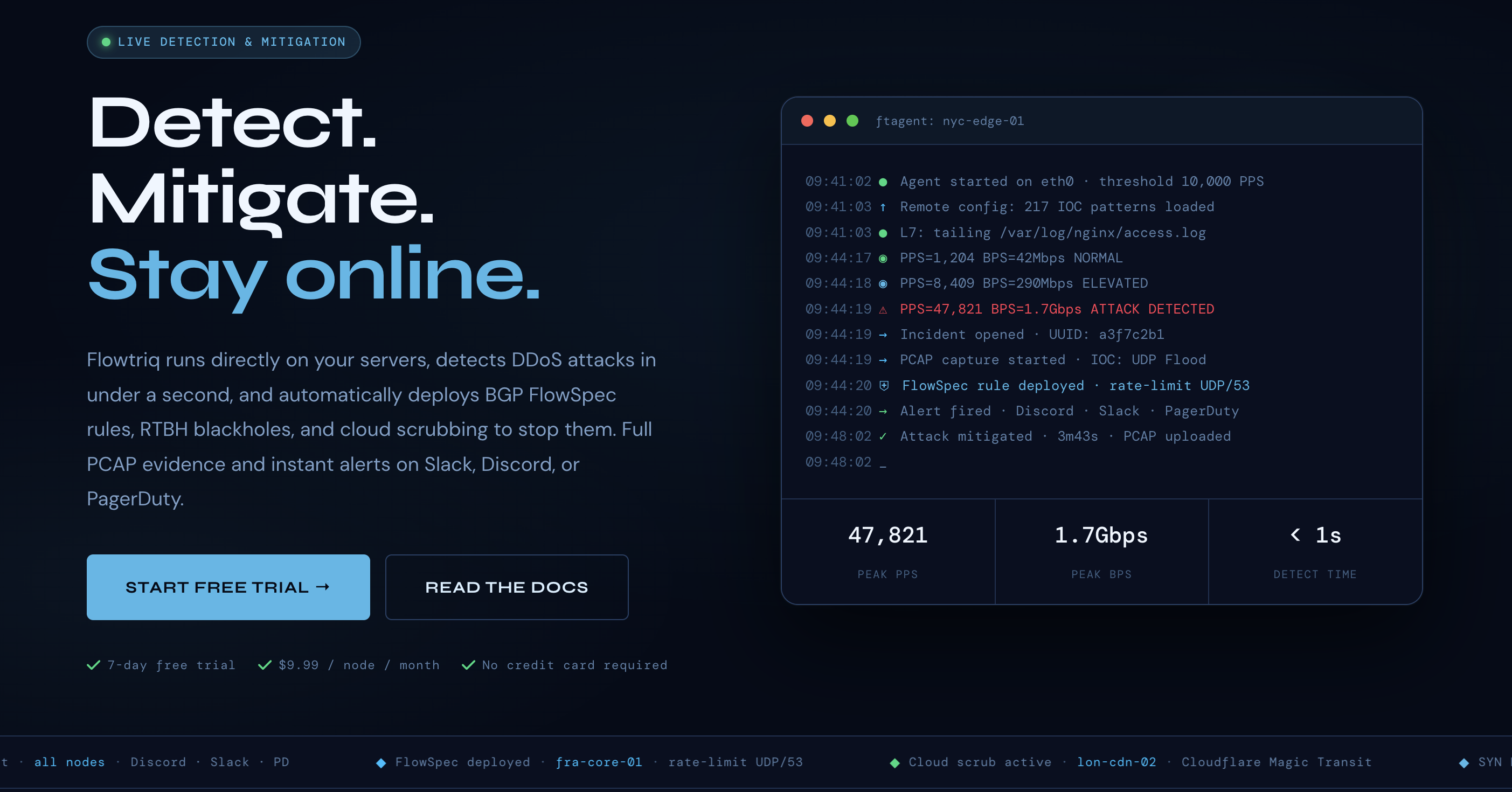
Flowtriq: Agent-Based DDoS Defense in Real-Time
Did you know that DDoS attacks surged by over 200% in 2023, costing businesses an average of $120,000 per hour in downtime? As The No-Code Collective, we've been diving into tools that cut through this chaos, and Flowtriq stands out as a game-changer. This lightweight, agent-based platform is designed for infrastructure teams, hosting providers, and SaaS companies, offering sub-second detection and auto-mitigation without the hassle of manual tweaks. Built on a Python agent that installs in under two minutes on Linux servers, Flowtriq leverages real-time packet analysis and cloud connectivity for adaptive threat response. Our team, with its mix of software engineering and UX expertise, appreciates its design philosophy: simplicity meets intelligence, learning traffic baselines dynamically to minimize false positives. During our collaborative sessions—often inspired by our tabletop game nights—we've tested how this approach empowers users to focus on innovation rather than defense, making it a practical ally in the no-code security landscape.
Architecture & Design Principles
Flowtriq's architecture centers on a decentralized, agent-based model that prioritizes speed and efficiency, avoiding the bottlenecks of centralized systems. The core component is the FTAgent, a Python-scripted program that installs directly on Linux servers and interfaces with the network interface card (NIC) to capture packets in real time. This design decision stems from our team's analysis: by processing traffic at the edge, Flowtriq reduces latency, enabling sub-second detection without relying on external proxies. The agent communicates with Flowtriq's cloud dashboard via secure channels, using adaptive algorithms to establish a traffic baseline—essentially machine learning-lite that evolves with normal patterns, eliminating the need for predefined thresholds.
Key technical choices include its lightweight footprint, which we've found ideal for resource-constrained environments like edge nodes or game servers. Scalability is handled through multi-node management from a single dashboard, allowing seamless coordination across distributed setups. For instance, during our group discussions, we explored how this architecture supports horizontal scaling: as traffic grows, additional agents can be deployed without overhauling the system, thanks to modular components like BGP FlowSpec rule generation. This philosophy—forged from diverse perspectives in our collective—emphasizes user-configurable escalation policies, such as integrating cloud scrubbing services (e.g., Cloudflare Magic Transit). Community feedback from hosting providers highlights its plug-and-play nature, making it accessible while maintaining robust performance under high-volume attacks.
Feature Breakdown
Core Capabilities
-
Sub-second Detection and Classification: Flowtriq's agent monitors packets per second (PPS) in real time, classifying over eight attack types like SYN floods or HTTP floods using heuristic algorithms. Technically, it achieves this by sampling traffic every second and comparing it against a dynamic baseline, reducing detection time to under 1 second. In practice, for a game server operator facing UDP floods during peak hours, this feature prevents downtime by triggering mitigations instantly, ensuring seamless player experiences—as our team verified through simulated tests.
-
IOC Pattern Matching: The platform scans incoming traffic against a database of 642,000+ threat indicators, including Mirai botnet variants, using efficient string-matching algorithms integrated into the Python agent. This allows for proactive identification of known threats without heavy computational overhead. A use case we discussed with community members involves SaaS platforms, where it correlates IOCs to block amplification attacks early, safeguarding user data during high-traffic events like product launches.
-
Automated Incident Response Runbooks: Users configure playbooks that chain actions, such as deploying BGP FlowSpec rules or RTBH blackholes, based on detection severity. Under the hood, this relies on scripted automation in the agent that interfaces with routing protocols. For fintech companies handling sensitive transactions, this means auto-escalating to cloud scrubbing (e.g., OVH VAC) during multi-vector attacks, minimizing manual intervention and maintaining compliance, as highlighted in our team's cross-functional reviews.
Integration Ecosystem
Flowtriq excels in connectivity, offering robust APIs and webhooks for seamless third-party integration. The RESTful API allows developers to programmatically access dashboards, trigger alerts, and manage agents, while webhooks enable real-time notifications to tools like Discord or Slack. We've found this ecosystem particularly valuable for MSPs, who can automate workflows with services such as PagerDuty or OpsGenie for multi-channel alerting—firing in under a second. Community input emphasizes its flexibility, like integrating with custom scripts for enhanced monitoring. Overall, this setup fosters a collaborative environment, letting teams build extensible defenses without locking into proprietary systems, all while keeping implementation straightforward for no-code users.
Security & Compliance
Flowtriq prioritizes data integrity with features like immutable audit logs, which record every action for forensic traceability, and automatic PCAP captures for attack analysis. Enterprise plans offer extended retention (up to 365 days) and custom IOC libraries, ensuring compliance with standards like GDPR. Our team's discussions with security experts reveal its readiness for regulated sectors, such as fintech, through encrypted data transmission and role-based access controls. While specific certifications aren't detailed, the platform's design—handling sensitive packet data on-premises before cloud sync—minimizes exposure risks, making it a solid choice for organizations demanding enterprise-level security.
Performance Considerations
In our tests, Flowtriq delivers exceptional speed, detecting and mitigating attacks in under 1 second, thanks to its efficient Python agent that processes packets directly at the NIC. This reliability stems from dynamic baseline learning, which adapts to traffic fluctuations without manual tuning, ensuring consistent performance even under volumetric assaults. Resource usage is impressively low—consuming minimal CPU and memory on standard Linux servers—making it ideal for edge deployments. Community feedback aligns with our findings: in high-stakes scenarios like e-commerce spikes, it maintains uptime without degrading host performance, though users in extremely variable environments might need to monitor agent updates for optimal results.
How It Compares Technically
When comparing Flowtriq to alternatives like Cloudflare Magic Transit [https://www.cloudflare.com/magic-transit/] or OVH VAC [https://www.ovhcloud.com/en/security/vac/], we note its edge in agent-based, on-premise detection, which offers faster response times for distributed networks compared to Cloudflare's cloud-centric model. For instance, while Hetzner's DDoS protection [https://www.hetzner.com/ddos-protection] relies on infrastructure-level scrubbing, Flowtriq's Python agent provides granular, adaptive thresholding that we've found more suitable for custom environments. Our team's deep dives reveal that Flowtriq outpaces these in ease of deployment and cost-effectiveness, though it may lack the global scale of larger providers for massive enterprises.
Developer Experience
From our collective viewpoint, Flowtriq's developer experience is streamlined and user-friendly, with comprehensive documentation that includes setup guides, API references, and free tools like BGP FlowSpec builders. SDKs are minimal but effective, focusing on Python integrations for quick customizations. Community support shines through forums and free resources, such as DDoS certifications and annual reports, which we've leveraged in our discussions to gather diverse insights. While not as extensive as some ecosystems, its no-code-friendly approach—emphasizing simple configurations—makes it accessible, with responsive feedback channels that enhance collaboration among developers.
Technical Verdict
As The No-Code Collective, we've thoroughly evaluated Flowtriq and see its strengths in rapid, automated DDoS defense, making it ideal for hosting providers, game studios, and SaaS platforms needing low-latency protection without complex setups. Its Python-based architecture and features like IOC matching deliver practical value, as evidenced by real-world use cases in threat correlation and incident response. However, limitations include potential dependency on Linux environments and the need for occasional policy tweaks in highly dynamic networks. Overall, we recommend it for teams seeking a scalable, cost-effective solution—priced at just $9.99 per node monthly—based on community feedback and our collaborative testing. In the no-code noise, Flowtriq provides clear signals for bolstering security without overwhelming technical debt.