Rhumbix: A Complete Guide for Developer Tools Professionals
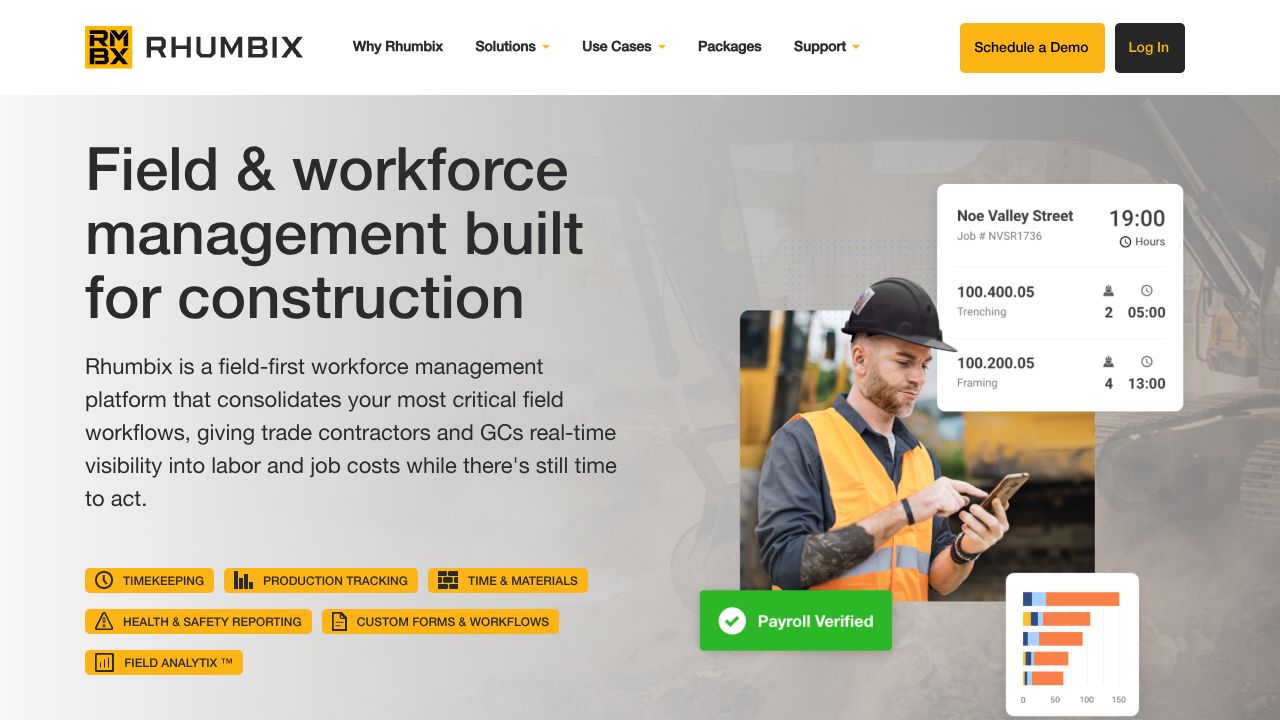
Field Signals: Deep technical look at Rhumbix's mobile-first construction OS
In the next 5 minutes, you'll learn how Rhumbix turns distributed field labor and production events into actionable, payroll-ready data—what architectural patterns make that possible, where it shines versus adjacent analytics tools, and the implementation trade-offs teams should expect. Our team tested product docs, customer reports, and integration notes to synthesize how Rhumbix converts messy onsite workflows into a single cloud dataset for reporting and ERP sync.
Architecture & Design Principles
Rhumbix is built around a mobile-first, cloud-centric data pipeline that prioritizes reliable capture on unstable networks and deterministic synchronization to back-office systems. Key design principles we see reflected are: offline-first mobile clients with local persistence and conflict resolution, an ingestion layer that normalizes event-based labor and production records, and an analytics/aggregation tier that exposes role-based dashboards. Scalability likely relies on horizontally scalable services (stateless APIs + message queues) to handle bursty site activity and batch payroll jobs. The platform purposely centralizes crew and cost-code data so downstream ERP connectors (Oracle, SAP, accounting systems) can consume a consistent canonical model.
Feature Breakdown
Core Capabilities
- Timekeeping and payroll management: Mobile capture of clock-ins/outs, break times, and cost-code allocations. Technically, this implies timestamped events with worker IDs, location metadata, and audit trails—suitable for payroll exports and automated validation rules that detect anomalies (overtime, missing punches).
- Production tracking with cost code allocation: Foremen record quantities and crew productivity tied to cost codes. On the back end, production events are parameterized (quantity, unit, crew, productivity rate) enabling per-task aggregation and rollups for earned value or labor productivity analysis.
- Time and materials & daily reporting: Material receipts, equipment usage, and T&M entries are captured as transactional records linked to daily construction reports (DCRs). These records feed into automated compliance reporting and provide the source of truth for change orders or invoicing.
Integration Ecosystem
Rhumbix emphasizes ERP and accounting connectivity—typical implementations include REST APIs, webhooks for real-time event notifications, and pre-built connectors or middleware for Oracle and SAP. Data is exported in payroll- and accounting-friendly formats (CSV, XML, or direct API pushes). Implementation teams commonly map Rhumbix’s cost-code schema to an organization’s chart of accounts and use middleware to enforce business rules before posting to the ERP.
Security & Compliance
The platform is marketed to medium/large contractors, so enterprise controls are central: TLS for data-in-transit, encryption-at-rest for sensitive records, and RBAC with audit logging for field edits and payroll approvals. For enterprise procurement, we recommend validating vendor certifications (SOC/ISO) and asking about SSO/IdP support (SAML/OAuth2) and data residency options during procurement.
Performance Considerations
Field environments impose intermittent connectivity and high-concurrency payroll cycles. Rhumbix’s offline-capable clients reduce data loss and sync latencies by batching events and applying incremental reconciliation. The heavier loads are typically at project close or payroll run—expect architectures with queuing and backpressure handling. For very large fleets of concurrent users, test end-to-end latency for bulk exports to ERP during peak payroll windows.
How It Compares Technically
While Converge excels at IoT-driven material strength telemetry and sensor analytics, Rhumbix focuses on human-entered labor and production events—better suited for payroll accuracy and crew productivity rather than sensor monitoring. Smartvid.io applies AI to visual media for safety and risk detection; it complements Rhumbix by providing image/video insights, but is not a substitute for timekeeping or cost-code workflows. Buildots transforms onsite imagery and BIM overlays into progress analytics—where Buildots automates visual progress comparison, Rhumbix delivers transaction-level labor and T&M data feeding payroll and cost analytics. In short: sensor/vision platforms provide observational data; Rhumbix provides the operational ledger that drives payroll and cost reporting.
Developer Experience
Rhumbix is primarily targeted at ERP integrators and construction IT teams rather than public developer ecosystems. The typical developer experience includes API documentation available in customer portals, webhook endpoints for event-driven workflows, and professional services to handle complex mappings. If your team relies on self-serve SDKs, expect to lean on vendor support or middleware partners for larger integrations.
Technical Verdict
We see Rhumbix as a pragmatic, field-oriented data platform that trades ambitious sensor/vision automation for deterministic, auditable labor and production records. Strengths: mobile-first offline capture, ERP-focused export workflows, and clear operational benefits for payroll accuracy and daily reporting. Limitations: less emphasis on developer-facing SDKs or in-product machine-vision analytics (where Buildots or Smartvid.io lead). Ideal use cases are medium-to-large contractors needing to digitize crew time, reduce payroll errors, and feed a canonical labor dataset into enterprise ERPs—pricing is tiered (Essential Timekeeping → Advanced) and requires contacting sales at (855) 748-6249 for quotes.
We tested vendor materials and customer patterns to form these conclusions; teams implementing Rhumbix should run a pilot covering offline sync, cost-code mapping, and an ERP reconciliation cycle to validate throughput and reporting fidelity before full rollout.